Within the HISER project it has been demonstrated at industrial scale (100 t/h) that ADR technology is effective in producing high quality aggregates from concrete waste.
One of the main environmental challenges in the construction industry is a strong social force to decrease the bulk transport of the building materials in urban environments. Considering this fact, applying more in situ recycling technologies for C&DW could be the key. To achieve this goal, a new low-cost classification technology, called Advanced Dry Recovery (ADR) has been developed (TUD). ADR performs purely mechanically and in the moist state, i.e. without prior drying or wet screening. It uses kinetic energy to break the bonds that are formed by moisture and fine particles and can classify materials almost independent of their moisture content. This choice reduces process complexity and avoids problems with dust or sludge. ADR is applied to remove the fines and light contaminants with an adjustable cut-point of between 1 and 4 mm for mineral particles. ADR separation has the effect that the aggregate is concentrated into a coarse aggregate product and a fine fraction which includes the cement paste and contaminants such as wood, plastics and foams. Within HISER, industrial ADR installation was demonstrated in Hoorn in the Netherlands and this successful demonstration was the result of a detailed design and built engineering.
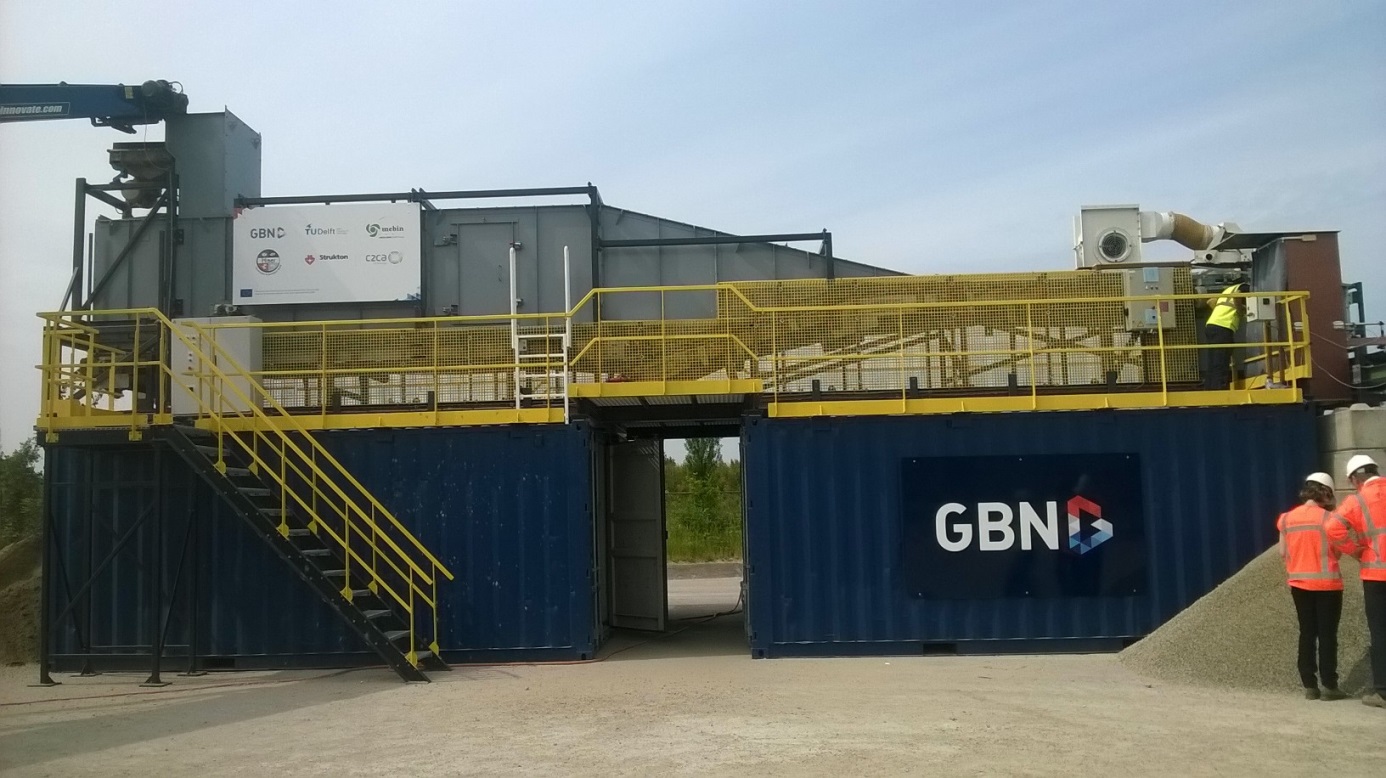
ADR in operation at GBN site in Hoorn (June 2016)