
SPIE holds for “Society of Photo-Optical Instrumentation Engineers” and is an American not-for-profit society for optics and photonics technologies since 1955. It organizes technical conferences, trade exhibitions, and education programs for researchers and developers in the light-based fields of physics, including optics, photonics, and imaging engineering. Within the framework of these topics SPIE organized the largest and most important conferences everywhere.
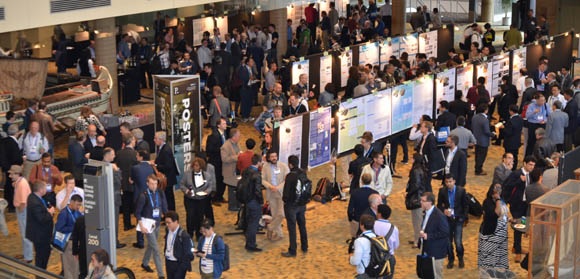
The symposium “Defense + Commercial Sensing (DCS)” is a set of conferences - in the past mostly hosted in Baltimore but with a designated 3-year rotation among Anaheim (California, 9 - 13 April 2017), Orlando (Florida, 15 - 19 April 2018), and Baltimore (Maryland, 14 - 18 April 2019) as of 2017.
The 2016-DCS consisted of 56 conferences with a total of over 5.000 participants and 2.000 presentations. The RTT/GAIKA contribution on behalf of HISER was embedded in SPIE-9862 (Advanced Environmental, Chemical, and Biological Sensing Technologies XIII), Session 3: Hyperspectral Techniques, and titled
|
Abstract There is great potential for recycling of construction and demolition waste (C&DW) materials since they content valuable resources. But new C&DW is more complex than existing one and there is a need for shifting from traditional recycling approaches to novel recycling solutions. One basic step to achieve the objective is an improvement in sorting technology. Hyperspectral Imaging (HSI) is a promising candidate to support this process. The study describes experimental results with regard to detection of important C&DW material composites by VIS-NIR-HSI and a development path for an industrial implementation in automatic sorting lines. |
The talk was well attended and followed with interest - in particular by experts from the mining industry; it was the only presentation touching the field of sensor-based sorting of C&DW at DSC-2016. The second issue is yet another reminder how much the whole issue is still underestimated in overseas and other where and stresses the pioneering role of the EU-initiative HISER. The full text of the paper can be read in Proceedings of SPIE Vol. 9862, doi 10.1117/12.2220769.